Raghav Rao never fails in MISSY
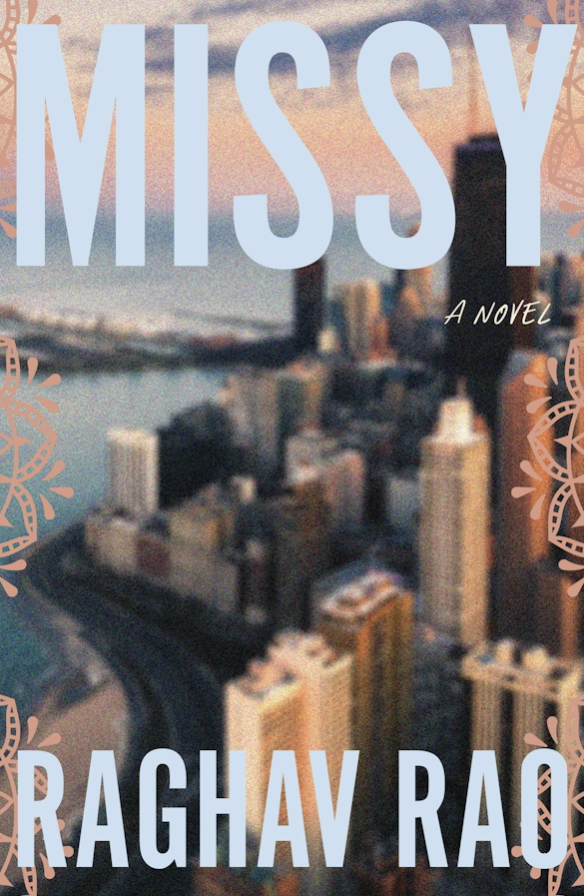
Raghav Rao keeps one foot in India and one foot in Chicago in his debut novel, Missy. A tale of immigration, family, and the love of place, homeland or not. His language, just as lush as where it takes you, transports to the gardens filled with sacred statuary, or the cramped offices overgrown with need and worry.
Filled with history and rooted in today’s issues, Missy has a flourishing amount of humor and heart, it’s a compassionate tale of familial bonds, the power of choice, or the power we steal from forced choice, and the cost of adapting. I spoke with Rao about this novel, the choices he made in weaving such a vivid and important tale, how Missy came to be more than just a character but a co-author, and the love it requires to fully see something.
CH: The book begins with a pivotal moment that ripples through Savi's life. What went into the decision to begin the book with this reveal?
RR: I'm a big believer that books instruct us on how they would like to be read, particularly in the early pages. By beginning the book with this moment, a fateful moment with a big decision in it for Savi, I was aiming for the reader to come away with the impression that this is someone to whom life doesn't just happen to. Savi makes decisions. She takes action. She makes choices that affect the trajectory of her life.
Had I proceeded purely chronologically with her earliest years in which she doesn't have much agency, I was concerned that readers may misread the underlying values of the book; for me, this book contends that to exist in the world is to countenance risk and that we cannot know outcomes when we make decisions and yet we must move forward and make decisions.
CH: There is such a balance in the language regarding the different settings. What was it like to capture the beauty and also the ugliness of each place yet never villainize either one?
RR: To love a place, or a person for that matter, calls for honesty and there is honesty in looking closer so that you see even the parts that don't want to be seen. To respect something means seeing its fullness. Etymologically, 'spect' is tied to sight – inspection, spectate, spectacles – and the prefix 're' means to repeat so 'respect' is seeing again and again until you get the fuller picture.
The opposite of respect is not to see something, to render it invisible. To ignore the ugliness, a place's open secrets, would be to fail in loving.
It's the same with America; I'm a naturalized citizen and I love America. Consequently, I think it's important to draw attention to its many uglinesses.
Thank you for seeing what I was going for and I'm touched by your choice of words to characterize my language.
CH: When we meet Savi, now known as Missy, years later, her experience of escape and immigration is one that feels increasingly of the moment. Her American dream isn't always dreamy, can you talk about the experience of writing such a character that is running from so much and yet holds such hope so tightly?
RR: Missy wrote her way from the periphery to the center; her force of will was extraordinary. She began as the backstory to a secondary character in a book that never came into existence and gradually she pushed and scraped and charmed her way to center-stage.
She is an extraordinary person and, at times, I don’t feel as though I ‘wrote’ her but rather that she and I collectively co-authored her story. She was never intended to be the main character but she ended up even claiming the title of the book as her own.
Her journey mirrors my understanding of the American dream; it’s not just about economic migration; it’s about self-determination, freeing oneself from the social roles of one’s previous life, choosing new names, careers, outfits, forms of self-expression.
But, as you observed, there is a shadow side to America and there is a latent ugliness that even those of us who love the open-heartedness of this country cannot afford to ignore.
Ultimately, I see Missy and her daughters as the dramatization and fictionalization of several open questions regarding how immigrants and the children of immigrants approach assimilation and self-determination. And I’m grateful to Missy and her daughters for giving me the chance to work through my own internal conflicts and value fluxes in their raucous, warm company.
Raghav Rao’s debut novel, Missy, is available through TriQuarterly Books. For more information about Rao and his work, visit raghavrao.com.